
Water Heaters · 6 min read
Where Can a Water Heater Go in a Jacksonville Home? Garage, Closet, Attic — and What Changes the Quote
The location of a water heater in a Jacksonville house decides more than where the hot water comes from. It decides whether you need a pan and drain line, a raised platform, a gas line or a bigger circuit — and therefore what the installation costs.
By The God Plumber · Florida plumbers, in business since 2015 · Published · Updated
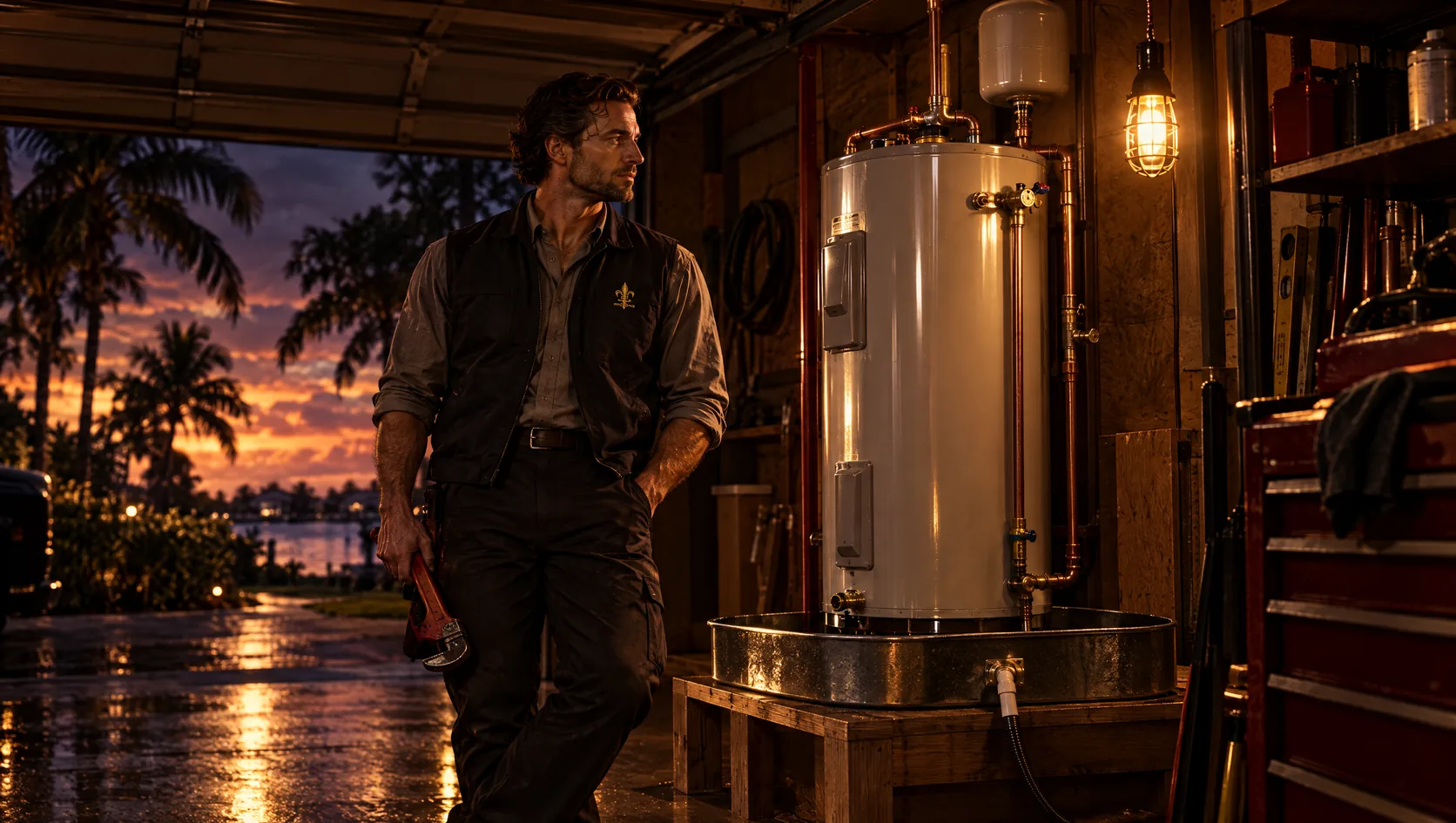
In a Jacksonville home a water heater can be installed in the garage, in an interior utility closet, in a laundry room, or in the attic — and each location carries its own requirements that change what the installation involves. A garage install is the simplest and most common on the First Coast. An interior closet or attic install adds a drain pan piped to a safe outlet, because a leak there damages the house. A gas unit in a garage sits on a raised platform. Tankless units open up wall locations a tank never could. Where the heater goes is the single biggest factor in a water heater installation quote after the unit itself, which is why an honest plumber looks at the spot before naming a price.
One rule before any of it: the City of Jacksonville lists replacement of a water heater among the repairs that require a permit, and it excludes water heaters from the no-permit exemption that covers swapping a faucet or another fixture. Wherever the heater ends up, the job is permitted and inspected.
Jacksonville houses put heaters in every one of those places. Post-war and 1950s–70s homes in Arlington, Southside and the Westside usually have a tank in the garage or a utility room off the kitchen. Older Riverside, Springfield and San Marco houses often hide one in an interior closet or under a stair. Newer construction in St. Johns County, Nocatee and the Oakleaf side of Clay County sometimes puts it in the attic to free up floor space. The rules that follow apply across all of them.
Is the garage the best place for a water heater in Florida?
For most Jacksonville homes, yes. A garage floor is concrete, a leak there runs to the door rather than into a bedroom, there is room for an expansion tank and a proper relief-valve discharge, and the heater is easy to reach for service and eventual replacement. Two things change for a gas heater in a garage: the burner has to sit above floor level, so the unit goes on a platform to keep the flame away from any fuel vapor that pools low in a garage, and the unit needs protection from being struck by a vehicle where it stands in a parking path. An electric heater needs neither, which is one of the reasons electric is so common on the First Coast.
What changes when the heater is inside the house?
Everything to do with water damage. A heater in a closet, a laundry room, or an attic sits over living space or finished floors, so the installation includes a drain pan under the tank and a drain line from that pan to somewhere the water can go — outdoors, a floor drain, or an approved indirect connection. The temperature-and-pressure relief valve needs a discharge line to a safe point too. In a closet, clearances for service and for combustion air on a gas unit have to be met, which is often what rules a gas tank out of a small interior closet and points the homeowner toward electric.
Attic installs carry all of that plus access: the unit has to fit through the attic hatch or the scuttle, there has to be a solid platform and a walkway to reach it, and the pan drain has to run a long way to daylight. A tank in a Jacksonville attic also lives in a space that is very hot for much of the year, which is not a problem for the heater but is worth knowing for whoever services it. When an attic tank reaches the end of its life, many homeowners take the opportunity to move it — to the garage, or to a tankless unit on an exterior wall — rather than repeat the attic install.
The pan is not a formality. A drain pan with a proper drain line is what turns a failing tank in a closet into a puddle outside rather than a soaked subfloor, wet drywall and a claim. If a quote for an interior install does not mention the pan and where it drains, ask.
Gas or electric — which does a Jacksonville home get?
Whichever the house already has, in most cases. If there is natural gas at the house, a gas tank or gas tankless is usually the more economical to run and recovers faster. Where the street has no gas service — which covers a great deal of Duval, Clay and St. Johns County — electric is the default, and the practical questions become the size of the circuit and the breaker panel's spare capacity. Switching from electric to gas means running a gas line and a flue; switching from gas to electric means a new dedicated circuit. Both are legitimate jobs, and both change the quote in ways a like-for-like swap does not.
Where does a tankless water heater go?
On a wall, which is the main advantage of a tankless water heater. A gas tankless can mount on an exterior wall with a short direct vent, or inside a garage with a vent through the wall or roof. An electric tankless mounts almost anywhere the electrical capacity allows — and that capacity is the real constraint, because whole-house electric tankless units draw far more current than a tank and often need panel work. In Jacksonville the other constraint is the Floridan aquifer's hard water: scale builds inside a tankless heat exchanger faster here than in soft-water regions, so the unit needs isolation valves for periodic flushing and, in many homes, a scale filter or softener ahead of it.
What is on every water heater installation, regardless of location?
- A permit and inspection. A water heater replacement in Florida is permitted work, and a legitimate quote includes it rather than leaving it off to look cheaper.
- A thermal expansion tank on a closed system, which most Jacksonville homes with a backflow preventer or pressure-reducing valve at the meter are.
- A temperature-and-pressure relief valve with a discharge line run to a safe location, never capped or plugged.
- New flexible water connectors and, on a gas unit, a new sediment trap and a leak test on the gas connection.
- Draining, disconnecting and hauling away the old unit — the old tank is not your problem once we leave.
- A walkthrough: where the shut-off is, how to set the temperature, and how to drain a few gallons from the tank each year to slow sediment from the hard water.
How does location change the quote?
In a fairly predictable order. A like-for-like electric tank in a garage is the simplest job. Adding a platform for a gas unit, a pan and drain line for an interior closet, a long pan drain and an attic platform, a new gas line or a new electrical circuit, or a tankless conversion each add real materials and real time, and the price moves with them. What should never move is the way the price is given: in writing, itemized by what the location requires, before the old heater is disconnected. If the plumber cannot explain why the closet install costs more than the garage install, the number is not an estimate, it is a guess.
If your Jacksonville water heater is due — or you are weighing whether to keep it in the attic, move it to the garage, or go tankless — call the Jacksonville line at 954-594-1667 or book a visit at a time that suits you. We will look at the location, tell you what it actually requires, and put the whole installation in writing before any work starts.
Sources
- City of Jacksonville Building Inspection Division, FAQs — replacement of water heaters requires a permit; fixture replacement after the stop is exempt, excluding water heaters